
– overview
Each archipelago has its own weather, its own culture, its own reason to sail there. Low coral atolls barely rising above the waterline. Volcanic peaks wrapped in turquoise lagoons. Sheer cliffs falling straight into the open ocean. Each is its own kind of trip.
– at a glance
Where Holoholo sails.
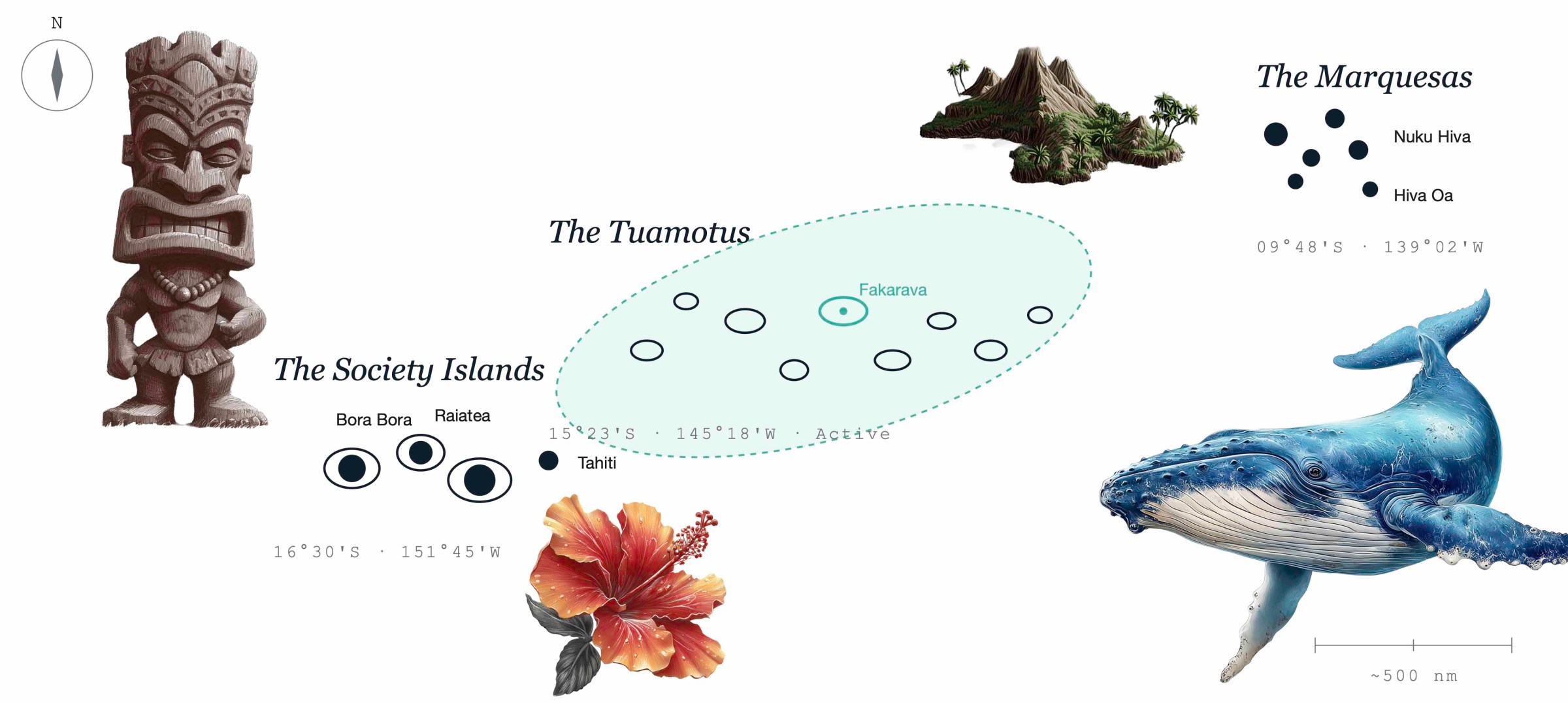
FRENCH POLYNESIA ~ SCHEMATIC ~ NOT AT SCALE.
ARCHIPELAGO 1
THE TUAMOTOS
~ 78
low-lying coral atolls
1,800 km
of ocean between them
UNESCO Biosphere Reserve
at Fakarava since 1977
CURRENT VOYAGE DESTINATION
ARCHIPELAGO 2
THE SOCIETY ISLS.
14
hig volcanic islands
Named by
Captain Cook, 1769
UNESCO World Heritage
at Taputapuātea since 2017
ON REQUEST
ARCHIPELAGO 3
THE MARQUESAS
12
volcanic islands (6 inhabited)
1,371 km
northeast of Tahiti
UNESCO World Heritage
since 2024 – Te Henua Enata
ON REQUEST
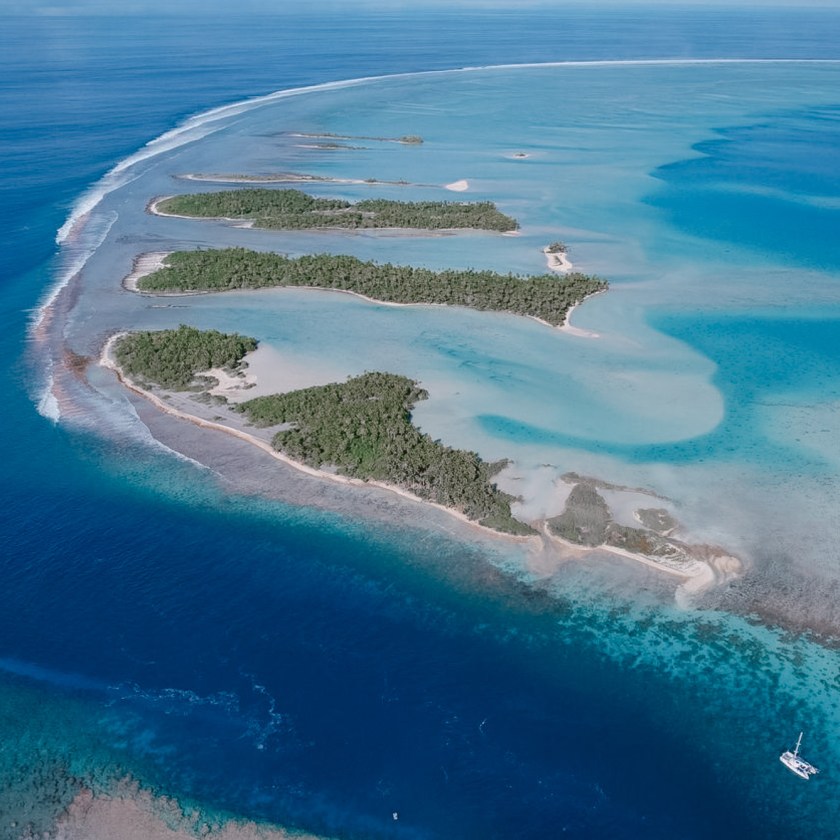
— 16° 06′ s · 145 37′ · fakarava
The largest chain of coral atolls in the world.
Around 78 low-lying atolls scattered across 1,800 kilometres of open Pacific. Each one is a ring of coral surrounding a lagoon. Between the atolls: nothing but ocean. On the atolls: coconut groves, one or two villages, small pearl farms, endless white beach.
The Tuamotus are where Holoholo lives.
CURRENT VOYAGE DESTINATION
— three things worth knowing
01 · THE PASSES
Where the lagoons breathe.
Each atoll has one or two narrow gaps in its coral ring — the passes — through which the entire lagoon breathes with every tide. Sailors time arrivals for slack water. Marine life concentrates here: sharks, rays, dolphins, schooling barracuda. Fakarava’s Tumakohua Pass is home to the famous ‘wall of sharks.’
02 · FAKARAVA
A UNESCO Biosphere Reserve
Since 1977, along with six neighbouring atolls. 60 km long, second-largest lagoon in French Polynesia. Fewer than 900 residents. No resorts, one village, one paved road. This is where most Tuamotus itineraries anchor.
03 · PEARL FARMING
The world’s source of the black pearl.
The Tuamotus produce most of the world’s Tahitian black pearls. Family-run pearl farms dot the lagoons. A visit is almost always part of the trip — grafting, formation, pick your own to take home.
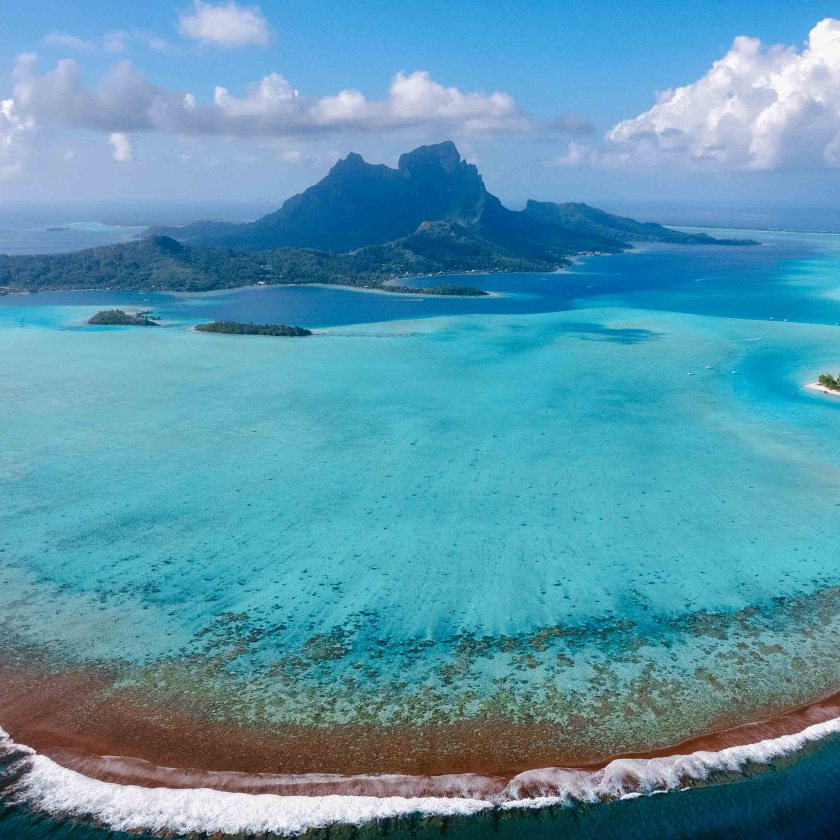
— 16° 30′ s · 151° 45′ · bora bora
Where French Polynesia became legendary.
French Polynesia, they picture the Society Islands — Bora Bora’s twin peaks, Moorea’s jagged skyline, Tahiti’s markets. Captain Cook named the archipelago in 1769 for the Royal Society, which had funded his voyage to observe the transit of Venus.
AVAILABLE ON REQUEST
— three things worth knowing
01 · TAPUTAPUÃTEA
The heart of Polynesian civilisation.
The most important marae in all of Polynesia. Once the religious and political centre of the entire Polynesian Triangle — Hawaii to New Zealand to Easter Island. UNESCO World Heritage since 2017.
02 · TAHA’A
The Vanilla Island
Around 80% of Tahitian vanilla is grown on a single small island — Taha’a. The lagoon between Taha’a and Raiatea is one of the most protected sailing waters in French Polynesia.
03 · THE TRANSIT OF VENUS
Where modern astronomy came to measure the sky.
Captain Cook’s 1769 expedition to Tahiti had a scientific mission: observe the transit of Venus across the Sun from the southern hemisphere, part of a coordinated global effort to calculate the Earth’s distance from the Sun. Point Venus, on Tahiti’s north coast, is named for the observation. It marks the moment French Polynesia first appeared on the modern world’s map.
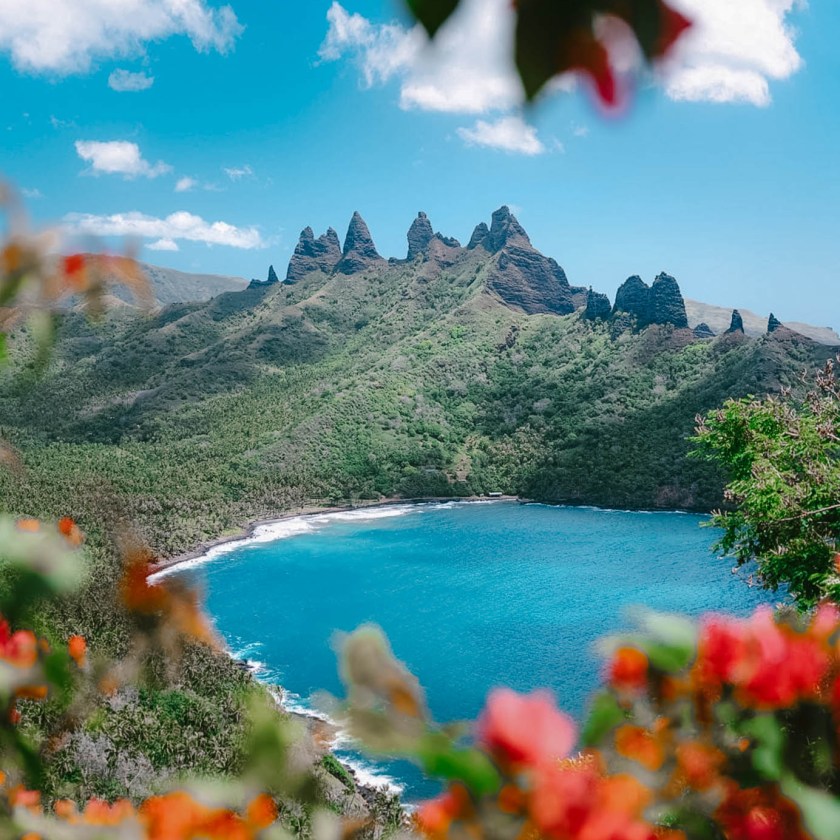
— 09° 48′ s · 139° 02′ · nuku hiva
Wild, remote, unlike anywhere else.
Twelve volcanic islands rising sheer from the open ocean, more than 1,300 kilometres northeast of Tahiti. No surrounding reefs — the Marquesas are young, and the coral hasn’t grown yet. That means no calm lagoons, no easy anchorages, and steep trade-wind swells breaking against black volcanic cliffs. Fewer than 11,000 visitors reach them in a year.
AVAILABLE ON REQUEST
— three things worth knowing
01 · UNESCO 2024
Te Henua Enata — The Land of Men.
Twelve volcanic islands rising sheer from the open ocean, more than 1,300 kilometres northeast of Tahiti. No surrounding reefs — the Marquesas are young, and the coral hasn’t grown yet. That means no calm lagoons, no easy anchorages, and steep trade-wind swells breaking against black volcanic cliffs. Fewer than 11,000 visitors reach them in a year.
02 · THE ARTISTS
Gauguin, Brel, Melville.
Herman Melville jumped ship at Nuku Hiva in 1842 and wrote Typee. Paul Gauguin spent his final years on Hiva Oa. Jacques Brel is buried a few metres from him.
03 · TATAU
Where the word tattoo came from.
The English tattoo comes from Marquesan/Tahitian tatau. The traditional Marquesan tattoo — dense, geometric, deeply symbolic — is one of the most sophisticated body-art traditions in the world.
— when to sail
The austral winter.
JAN — MAR
Off – season
APR / NOV
Shoulder
MAY — OCT
Voyage season
DEC
Maintenance
Trade winds settle in from the east, humidity drops, and the passes run cleaner. Water stays warm year-round — around 27–29°C.
Ready to sail the Tuamotus?
For Society Islands and Marquesas voyages, get in touch